
EC Sales List (Zusammenfassende Meldung) for German Freelancers
Complete guide to the EC Sales List (Zusammenfassende Meldung) 2026: filing obligation for EU business, deadlines for goods and services, EUR 50,000 threshold, corrections, and BZSt submission steps.
- Category
- Taxes
- Updated
- Author
- Diana Chebotareva
The EC Sales List (Zusammenfassende Meldung, or ZM) is a mandatory report submitted to the Federal Central Tax Office (BZSt) by any VAT-registered business in Germany that sells goods or provides services to businesses in other EU member states. This guide explains who must file, which 2026 deadlines apply to goods versus services, when the EUR 50,000 threshold kicks in, and how to submit the report at the BZSt step by step.
Key Facts at a Glance
- The ZM reports your VAT-free B2B sales to customers in other EU countries to the BZSt, on top of your regular VAT return (UStVA).
- It is always due by the 25th day after the end of the reporting period, there is no deadline extension.
- Goods must be filed monthly once they exceed EUR 50,000 in a quarter, otherwise quarterly. Services (reverse charge) are filed quarterly, the EUR 50,000 threshold does not apply to them.
- A nil return is not required: you only file for periods in which you actually had EU sales.
- Errors must be corrected within one month (§18a(10) UStG). Missing the deadline can trigger a late-filing surcharge, a fine of up to EUR 5,000, and a coercive penalty.
What Is the EC Sales List?
The EC Sales List is a tax report you submit to the BZSt whenever you make intra-community supplies of goods or provide reverse-charge services to businesses in other EU member states. It serves the EU-wide cross-check of cross-border trade between companies.
The logic behind it: your EU B2B sales are VAT-free in Germany because your customer accounts for the tax in their own country (reverse charge). To stop that from becoming a loophole, the EU matches the data: you report through the ZM who you supplied and how much, and your customer reports the same acquisition in their country. If the figures don't match, one of the two tax authorities follows up.
EC Sales List vs. VAT Return: The Difference
The ZM does not replace the VAT return (UStVA), the two run in parallel but go to different authorities and serve different purposes.
| Feature | VAT return (UStVA) | EC Sales List (ZM) |
|---|---|---|
| Recipient | Local tax office | Federal Central Tax Office (BZSt) |
| Content | All turnover incl. VAT due | Only VAT-free EU B2B sales |
| Purpose | Calculate and pay tax | Control data for the EU |
| Per-customer detail | No (totals only) | Yes, VAT ID + amount per customer |
| Deadline extension | Possible | Not possible |
| Deadline | 10th of the following month | 25th after the reporting period |
Who Must File?
In principle, any business making B2B sales within the EU must file. Under §18a UStG, the obligation covers three cases:
- Intra-community supplies of goods, you sell goods to a business in another EU country and the goods are physically transported there. The supply is VAT-free in Germany but must be declared in the ZM. See our guide to the intra-community supply.
- Intra-community services (reverse charge), you provide services to a business in another EU country where the recipient becomes liable for the VAT (e.g. IT consulting, design, marketing). We explain the reverse-charge mechanism separately.
- Triangular transactions, a special case involving three businesses in three different EU countries, where the goods move directly from the first to the last.
You always need a valid VAT ID, both your own and your customer's. Without it you can neither invoice VAT-free nor file the ZM correctly.
If you only do domestic business or sell exclusively to private individuals in the EU, you don't file a ZM. Sales to EU consumers go through the OSS scheme instead.
Small-business owners (Kleinunternehmer): anyone using the small-business rule is generally exempt from the ZM (§18a(4) UStG). But: if you provide reverse-charge services to EU businesses as a small-business owner (say, as a developer for a client in Austria) you need a VAT ID and must report those services in the ZM. The small-business exemption does not apply here.
Deadlines 2026: Monthly or Quarterly?
The ZM must always be transmitted electronically by the 25th day after the end of the reporting period. Whether your reporting period is a month or a quarter depends on what you report, and this is the most common misunderstanding: goods and services follow different rules.
| What you report | Reporting period | When monthly? |
|---|---|---|
| Goods (intra-community supplies, triangular deals) | Quarter | Once supplies exceed EUR 50,000 in any of the last four quarters, then monthly from the following month |
| Services (reverse charge) | Quarter | Only voluntarily, or if you already file monthly because of goods |
The EUR 50,000 threshold applies exclusively to supplies of goods, not to services. A pure service provider (a consultant or developer, say) therefore stays on the quarterly schedule no matter how high their EU turnover. If you report both and cross into monthly filing on the goods side, the services move into that same monthly period.
Note: unlike the UStVA, there is no permanent deadline extension (Dauerfristverlängerung) for the ZM. The 25th is a hard deadline. If it falls on a Saturday, Sunday, or public holiday, it moves to the next working day (§108(3) AO).
Example dates 2026 (quarterly filing)
| Reporting period | Statutory date | Effective deadline |
|---|---|---|
| Q1 2026 (Jan–Mar) | 25 Apr 2026 (Sat) | 27 Apr 2026 |
| Q2 2026 (Apr–Jun) | 25 Jul 2026 (Sat) | 27 Jul 2026 |
| Q3 2026 (Jul–Sep) | 25 Oct 2026 (Sun) | 26 Oct 2026 |
| Q4 2026 (Oct–Dec) | 25 Jan 2027 (Mon) | 25 Jan 2027 |
For a calendar of all other VAT dates, see our VAT deadlines 2026 guide.
Step by Step: Filing at BZSt
You submit the ZM electronically only. Here is the process:
- Step 1: Open the portal, log in to the BZSt online portal (BOP) or via your ELSTER account. Both routes lead to the same form.
- Step 2: Enter VAT ID and taxable amount, for each customer, enter their VAT identification number (VAT ID) and the total taxable amount in whole euros. You report the net amount, no VAT applies here by definition.
- Step 3: Specify the type of transaction, mark each line as an intra-community supply of goods, a reverse-charge service, or a triangular transaction. Correct classification is essential.
- Step 4: Submit, review the entries and transmit. You receive a confirmation receipt as proof. Keep it with your records.
Common Mistakes
Even experienced business owners trip up on the ZM. The most frequent traps:
| Mistake | Consequence | How to avoid it |
|---|---|---|
| Wrong/invalid VAT ID | Rejection by the BZSt | Confirm the VAT ID before invoicing |
| Confusing supplies and services | Wrong classification, queries | Record goods and services separately |
| Filing the ZM late | Late surcharge, fine | Mark the 25th as a hard deadline |
| Not correcting an error | Sanctions despite good faith | Correct within one month |
Two things we see all the time: entrepreneurs who completely forget about the ZM, and entrepreneurs who are afraid to file it. But the ZM doesn't trigger any additional tax; it's just a report. File it right after your VAT return and sleep peacefully.
 Peter BoykoFounder of Norman
Filing the ZM late or not at all risks a fine of up to EUR 5,000 per reporting period (§26a UStG). The BZSt can also impose a late-filing surcharge (up to EUR 2,500) and a coercive penalty (up to EUR 25,000, repeatable) to enforce submission.
Correcting a ZM: The One-Month Deadline
If you later discover that a submitted ZM was incorrect or incomplete, you must correct it within one month of noticing (§18a(10) UStG). This applies to a wrong VAT ID just as much as to a forgotten sale or an incorrect amount. The correction runs through the same portal, you fix the specific reporting period, not your entire history. Let the one-month window lapse and you risk the same sanctions as a late initial filing.
Frequently Asked Questions
Must I file a ZM as a small-business owner?
Usually no, small-business owners are exempt under §18a(4) UStG. The exception: if you provide reverse-charge services to businesses in the EU, you need a VAT ID and must report those sales in the ZM.
Do I have to file a nil return if I had no EU sales?
No. There is no "nil return" for the ZM as there is for other tax filings. You only file for the periods in which you actually made intra-community sales.
Monthly or quarterly, which applies to me?
Pure service providers almost always file quarterly. You only move into monthly filing if your supplies of goods exceed the EUR 50,000 threshold in any of the last four quarters. Services don't count towards that threshold.
How do I correct a faulty ZM?
Through the BZSt online portal or ELSTER: you file a corrected ZM for the affected reporting period, within one month of noticing the error (§18a(10) UStG).
Is the ZM the same as an Intrastat declaration?
No. The ZM is a tax report to the BZSt with no lower limit, even the first euro of EU turnover is reportable. The Intrastat declaration is a statistical report to the Federal Statistical Office and only applies once your dispatches to other EU countries exceed EUR 1 million or your arrivals exceed EUR 3 million per year. Most freelancers and small businesses are therefore not affected by Intrastat at all.
Do I need a VAT ID for the ZM?
Yes, both your own and your customer's. Our step-by-step guide shows how to apply for a VAT ID.
Automate with Norman
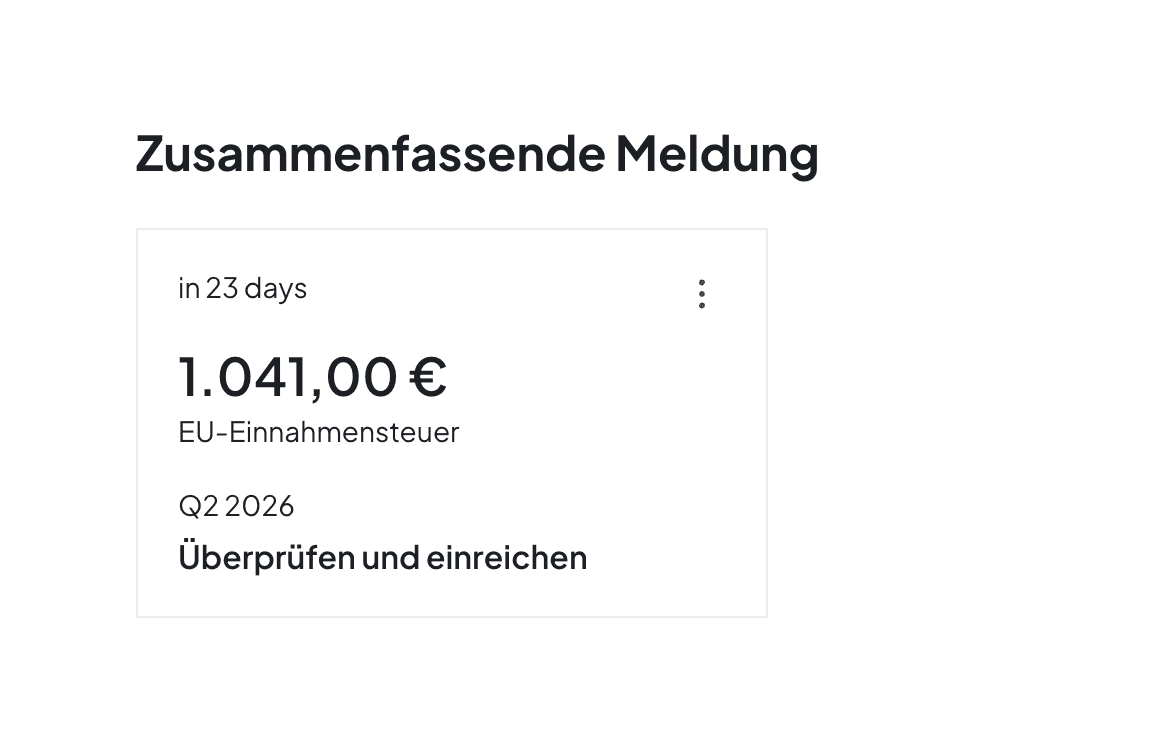
Manually tracking EU invoices and filling out the BZSt form every period is tedious and error-prone, especially if you have many EU customers. Norman takes that off your plate:
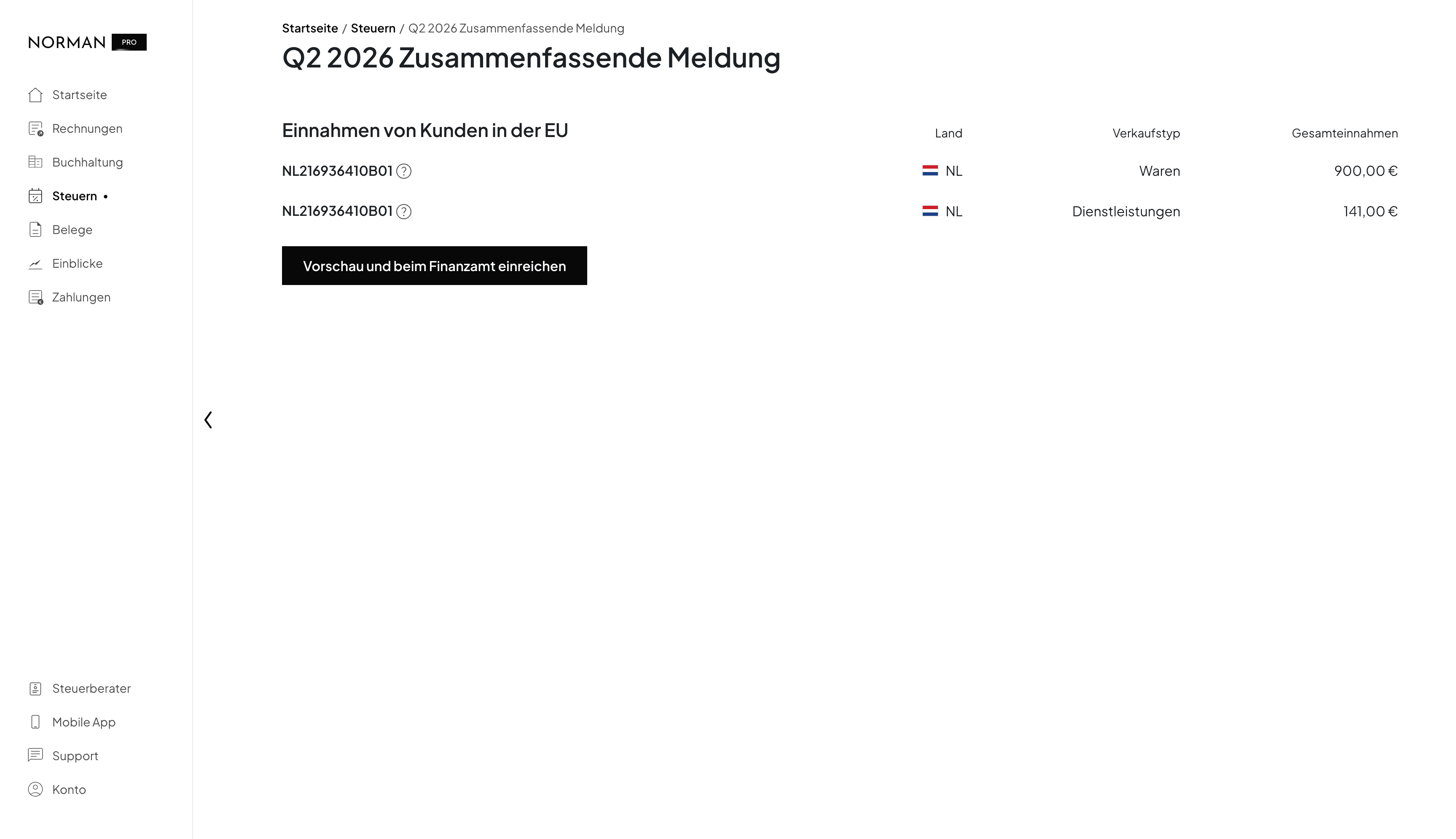
- Automatic EU transaction detection, Norman analyses your invoices and bank transactions and identifies intra-community supplies and reverse-charge services automatically.
- Automatic ZM creation, from your data, Norman compiles the report with all required details (VAT ID, taxable amount, transaction type) in the correct reporting period.
- Direct transmission to the BZSt, Norman submits the finished ZM electronically, so you never touch a separate portal.
That saves you time and minimises the risk of errors and late filings.
Norman spots your EU sales and files them with the BZSt
Norman analyses your invoices and bank transactions, automatically detects intra-community supplies and reverse-charge services, and compiles the EC Sales List with every VAT ID. You submit it to the BZSt in one click, on time and without typos.