
Input VAT Refund (Vorsteuerüberhang) in Germany 2026: Calculation, Timeline and Requirements
When the VAT you paid suppliers exceeds the VAT you collected from customers, you have a Vorsteuerüberhang, and the German tax office owes you money. Here's how to calculate it and get paid faster.
- Category
- Taxes
- Updated
- Author
- Diana Chebotareva
Paid more VAT to suppliers in a month than you charged your customers? Then you have a Vorsteuerüberhang (input VAT surplus), and the Finanzamt owes you money. Sounds easy, but there are strings attached: clean invoices, correct UStVA filings, and patience. Here's how a refund works in Germany, how to get paid faster, and the mistakes that block payout.
Key takeaways
- A Vorsteuerüberhang arises when your input VAT paid in a period exceeds the output VAT collected. The Finanzamt refunds the difference.
- You don't apply separately, the refund follows automatically from your UStVA. Requirement: an IBAN or SEPA direct debit mandate on file in ELSTER.
- Payout usually lands in 3 to 6 weeks, or 2 to 3 months for larger amounts that trigger a document check.
- Kleinunternehmer (§ 19 UStG) get no refund, they don't deduct input VAT in the first place.
- If you regularly run a surplus, switch to monthly filing, it's the fastest cash-flow lever.
What is a Vorsteuerüberhang?
A Vorsteuerüberhang occurs when the input VAT (Vorsteuer (VAT you paid on purchases) exceeds the output VAT (Umsatzsteuer) VAT you charged on sales) in a reporting period. The difference is refunded through your VAT advance return (UStVA). Legal basis: §§ 16 and 18 UStG; the input VAT deduction itself is governed by § 15 UStG.
Formula:
Input VAT surplus = Input VAT paid − Output VAT collected
A positive result means you have a credit with the tax office. A negative result is a Zahllast (VAT liability), then you pay the Finanzamt. The surplus isn't anything exotic; it's the normal VAT mechanism, mirrored: the state pays you instead of the other way around.
When does a Vorsteuerüberhang typically occur?
- Investment months: Buying a laptop, machinery, or office furniture creates a large block of input VAT in one period.
- Startup phase: Notary, IT, website, marketing, costs ramp before revenue does.
- Exports and reverse charge: Tax-free exports outside the EU or B2B reverse-charge invoices to other EU countries produce no output VAT, but your supplier invoices still carry German VAT you can reclaim.
- Seasonal businesses: Inventory bought in spring, sold in autumn.
- Large project with upfront subcontractor costs: Vorsteuer hits this month; you invoice the customer next quarter.
Important: Businesses using the Kleinunternehmer exemption (§ 19 UStG) can't claim a refund, they don't deduct input VAT in the first place. If your input VAT is consistently high, check whether waiving the exemption pays off.
A VAT refund is completely normal, especially at the start of a business, when your investments exceed your revenue.
 Peter BoykoFounder of Norman
Calculation examples
Example 1: Investment month
In March, a UG buys a server for €6,000 net plus €1,140 input VAT, and spends €500 net plus €95 VAT on software. The same month it invoices consulting work for €3,000 net plus €570 VAT.
| Transaction | Net | Rate | Output / Input VAT |
|---|---|---|---|
| Sale, consulting | €3,000 | 19 % | €570 output VAT |
| Purchase, server | €6,000 | 19 % | €1,140 input VAT |
| Purchase, software | €500 | 19 % | €95 input VAT |
| Balance | €665 refund |
- Input VAT: €1,140 + €95 = €1,235
- Output VAT: €570
- Vorsteuerüberhang: €1,235 − €570 = €665 refund from the Finanzamt
Example 2: Exports and reverse charge
In April, a freelancer invoices a French B2B client €5,000 net for consulting, with no German VAT, because the tax liability shifts to the client under reverse charge. The same month she buys hardware and software for €2,500 net plus €475 input VAT.
- Output VAT on sales: €0 (reverse charge)
- Input VAT on purchases: €475
- Vorsteuerüberhang: €475 − €0 = €475 refund
You report the reverse-charge turnover separately in the UStVA (lines 21 / 60), that doesn't cost you the refund.
Refund or offset, your choice
When your UStVA shows a surplus, payout happens automatically: no separate application needed. In ELSTER, though, you choose how the credit is handled:
- Refund (Erstattung): The Finanzamt transfers the surplus to your registered account. This is the default when you have no outstanding tax debts.
- Offset (Verrechnung): Tick the box "Verrechnung des Überschusses erwünscht" and the office keeps the credit, applying it against upcoming tax payments (e.g. payroll tax, corporate tax prepayments).
If you have tax arrears, the Finanzamt offsets first anyway and pays out only the remainder. Need liquidity? Choose the refund. Expect a liability soon? An offset saves the back-and-forth.
How long until the money lands?
The UStVA is due on the 10th of the following month (see VAT deadlines 2026). Once the Finanzamt processes your return, refunds typically arrive in 3 to 6 weeks. Prerequisite: a SEPA direct debit mandate or a refund bank account on file in ELSTER. Without one, nothing happens, the tax office holds the credit silently.
Large amounts or repeated refunds usually trigger a documentation request from the Finanzamt. That can push payout to 2–3 months. Keep scanned supplier invoices ready and you'll answer the query in days, not weeks.
If the Finanzamt doesn't pay at all: If the office fails to act on a correctly filed UStVA for more than six months, you can file an inactivity objection (Untätigkeitseinspruch, § 347 AO) and ultimately an inactivity suit. In practice, a call to the case officer usually resolves it.
What you need to qualify
Every input VAT claim requires a proper supplier invoice that meets § 14 UStG. The mandatory fields are:
- Full name and address of supplier and customer
- Supplier's Steuernummer or USt-IdNr.
- Invoice date, sequential invoice number, description of goods/services
- Net amount, applicable VAT rate (7 % or 19 %), tax amount, gross total
The expense must be business-related. Mixed-use items (a phone used 60 % for business) can only be deducted proportionally. For exactly what is and isn't deductible, see input VAT deduction for companies and freelancers.
Monthly filing: the fastest lever for cash flow
Whether you file monthly or quarterly depends on your prior-year VAT liability. Since 1 January 2025, the threshold raised by the Fourth Bureaucracy Relief Act (Bürokratieentlastungsgesetz IV) is €9,000 (up from €7,500):
| VAT liability 2025 | Filing period 2026 |
|---|---|
| over €9,000 | monthly (mandatory) |
| €2,000 – €9,000 | quarterly |
| up to €2,000 | Finanzamt may exempt you from advance returns (annual only) |
If you regularly run an input VAT surplus (exporter, early-stage company), you can voluntarily apply for monthly filing, the choice binds you for the calendar year. The payoff: you don't sit on a refund for a quarter; you collect it every month. With consistent refunds, that's working capital in your account instead of in Bonn.
Important clarification for founders: The old rule that new businesses must file monthly in their founding year and the year after has been suspended since 2021, and that suspension still applies in 2026 (its final year). New businesses fall under the normal thresholds above; in the founding year, your expected VAT decides. So if you're a founder who wants fast refunds, you must actively opt in to monthly filing, it no longer happens automatically.
Dauerfristverlängerung with a refund, usually counterproductive
A Dauerfristverlängerung pushes your filing deadline back by one month. That's handy when you owe VAT and want to hold your money longer. With a refund position the effect reverses: you file later, so you get paid later. If you run consistent surpluses, think twice before applying for the extension, or at least know that it delays payout by a month. The special prepayment (1/11 of prior-year VAT) is irrelevant for pure refund cases anyway.
Common mistakes that block your refund
- No IBAN on file in ELSTER, Finanzamt won't pay and won't always notify you.
- Receipts instead of invoices above €250 gross, small-amount invoice rules cap out below that threshold.
- Reverse charge mishandled: EU services need to be reported on your UStVA, both as output VAT and reclaimed input VAT in the same line. See EU B2B invoicing.
- Duplicate bookings: Bank import and receipt scan create two entries for the same invoice.
If you later realize you missed input VAT, you can amend the return, see How to correct a German VAT return.
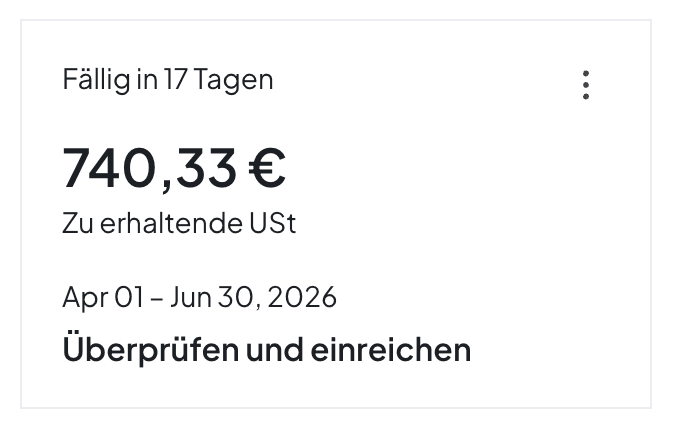
How Norman helps
Norman's AI bookkeeping captures supplier invoices automatically, books input VAT correctly, and flags reverse-charge cases. We submit your UStVA via ELSTER and tell you when a refund is coming. For GmbH/UG, there's a dedicated company tax module. Invoicing and bookkeeping are free; you only pay for tax filing.
Frequently asked questions
How long does an input VAT refund take?
Usually 3 to 6 weeks after the Finanzamt processes your UStVA, provided your figures are complete and an IBAN is on file. Larger amounts with a document check can take 2 to 3 months.
Do I have to apply separately for the refund?
No. The claim follows automatically from your UStVA. You only need a bank account on file in ELSTER, otherwise the Finanzamt won't pay out.
What's the difference between refund and offset?
With a refund, the Finanzamt transfers the credit to your account. With an offset (Verrechnung), it keeps the credit and applies it against upcoming tax payments. You can request the offset in ELSTER; existing tax debts are offset first regardless.
Can Kleinunternehmer claim an input VAT surplus?
No. Kleinunternehmer under § 19 UStG charge no VAT and deduct no input VAT, so no refund arises. With heavy investment, waiving the exemption can pay off.
Is monthly filing worth it with a permanent surplus?
Almost always. You collect your money every month instead of once a quarter, a real cash-flow boost. You apply for monthly filing at the Finanzamt; it binds you for the current calendar year.
What if the Finanzamt doesn't pay?
First check the IBAN on file in ELSTER. If the office hasn't acted on a correct UStVA after six months, you can file an inactivity objection under § 347 AO. Usually, though, a call to the case officer clears it up.
Conclusion
An input VAT surplus is the normal VAT mechanism in reverse: when your purchases exceed your sales, the state pays back what you advanced. What matters is a clean trail: proper invoices, an accurate UStVA, IBAN on file. Get those right and the Finanzamt refunds reliably. If you invest heavily or sell abroad, switch to monthly filing, that's working capital sitting in your account instead of in Bonn.
Get your input VAT back automatically
Norman captures your supplier invoices, books input VAT correctly, detects reverse-charge cases, and submits your UStVA to the Finanzamt via ELSTER, flagging the moment a refund is due. Invoicing and bookkeeping are free.