
Platform Tax Transparency Law (PStTG) 2026: What eBay, Etsy and Vinted Report to the German Tax Office
Since 2023, platforms like eBay, Etsy and Vinted have been reporting seller data to Germany's tax office. The first letters land in 2026, what gets reported, at which threshold, when private sales stay tax-free and when you need a business registration.
- Category
- Taxes
- Updated
- Author
- Diana Chebotareva
Since 1 January 2023, digital platforms such as eBay, Etsy, Vinted, Amazon, Airbnb and Uber have been required to report their sellers' data to Germany's Federal Central Tax Office (BZSt) every year. The legal basis is the Plattformen-Steuertransparenzgesetz (PStTG), Germany's implementation of the EU's DAC7 directive. The first mass data exchanges between platforms and tax authorities are becoming visible in 2026, and many sellers will receive letters from their Finanzamt this year.
In short: PStTG in 30 seconds
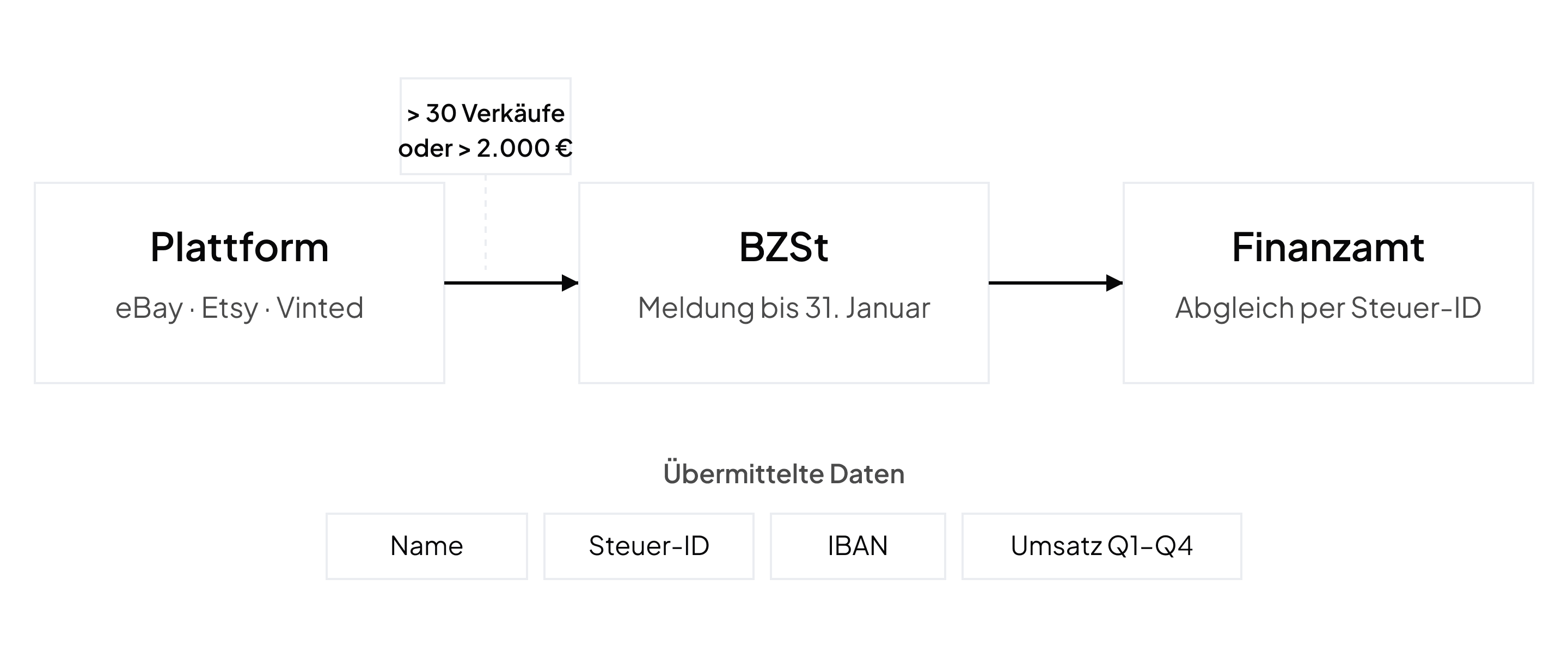
- What is it? A pure reporting obligation for platforms, not a new tax law. Platforms report once a year to the BZSt, by 31 January of the following year.
- When do they report you? As soon as you make more than 30 sales or more than €2,000 in revenue per year on a platform, one of the two thresholds is enough.
- Does reported mean taxed? No. Genuine private sales of used everyday items stay tax-free, no matter how many. Tax only arises if you trade commercially or resell valuables at a profit within a year.
- Got a letter? Don't ignore it. Work out whether you sold privately or commercially, and if commercial, register the business retroactively and prepare an EÜR.
What is the PStTG?
The Platform Tax Transparency Law requires platform operators to report active seller data to the BZSt once a year, by 31 January of the following year. Goal: uncover tax evasion through undeclared platform income. Germany's estimated annual tax loss in this area is over €300 million.
The report for the 2025 calendar year was therefore due by the end of January 2026. The Finanzamt then receives the data, matched via the Steuer-ID, and compares it with your tax filings. Key point: the PStTG creates no new tax law. Whether and how much tax you owe is still decided by regular income tax and VAT law. The only thing that's new is that the Finanzamt now sees your platform income automatically.
Which platforms are covered?
All platforms that broker the following are covered:
| Type of business | Example platforms |
|---|---|
| Sales of goods | eBay, Etsy, Vinted, Amazon Marketplace, Kleinanzeigen Marktplatz, Momox, Vestiaire Collective, Shpock |
| Property rentals | Airbnb, Booking.com (private rentals), Wimdu |
| Vehicle / movable-asset rentals | SnappCar, Drivy, Getaround |
| Personal services | Uber, Lieferando (for restaurants), Helpling, MyHammer |
Pure classified-ad listings without integrated payment processing are not covered, but as soon as a "secure payment" system runs through the platform, the reporting obligation applies.
The threshold: 30 sales or €2,000
A report is only triggered when at least one of these two thresholds is exceeded in the calendar year:
- more than 30 relevant transactions, or
- more than €2,000 in gross revenue (including shipping, before platform fees).
If you're a hobby seller offloading old items on Vinted or Kleinanzeigen and stay below both thresholds, you're not reported. But careful: on Vinted or Kleinanzeigen you can hit 30 transactions faster than you think, clearing out a wardrobe is easily 40 individual sales. And as soon as one threshold is crossed, the platform reports all the data for the year, not just the sales above the threshold.
| Scenario | Sales / year | Revenue / year | Reported? |
|---|---|---|---|
| Cleared out the basement once | 12 | €350 | No |
| Sold a wardrobe on Vinted | 45 | €900 | Yes (over 30 sales) |
| A few high-value items | 8 | €2,600 | Yes (over €2,000) |
| Regular Etsy shop | 120 | €6,000 | Yes (both thresholds) |
What exactly is reported?
The platform submits, per seller:
- Name, address, date of birth
- Steuer-ID (the personal tax identification number, not the Steuernummer)
- Bank details (IBAN)
- Number of transactions per quarter
- Gross revenue per quarter, minus fees, commissions and taxes withheld
- for commercial sellers, additionally the VAT ID (USt-IdNr.) and commercial register number
The Finanzamt now sees, down to the quarter, how much you sold and where, and compares it with your EÜR or your income tax return. That's exactly why it pays to record platform income from day one in the same quarterly grid the report uses.
Reported doesn't mean taxable: classifying private sales correctly
This is where most people panic unnecessarily. A report does not mean tax automatically falls due. What matters is what you sell and with what intent. You need to keep three cases apart:
| Case | Tax treatment | Legal basis |
|---|---|---|
| Used everyday items (clothing, furniture, books, household electronics) | Always tax-free, no matter how many, even at a profit | § 23(1) No. 2 EStG (the "everyday-use goods" exception) |
| Valuables (jewellery, art, coins, collectibles, crypto), resold within 1 year | Gain taxable, but €1,000/year exemption threshold | § 23 EStG (the one-year holding period) |
| Occasional services / rentals (e.g. a drill, a parking space) | €256/year exemption threshold for other income | § 22 No. 3 EStG |
Everyday items are the normal case. Selling your cleared-out wardrobe, old furniture or a used phone costs you nothing in tax, not even if there's a small gain at the end, and not even across a hundred sales. The legislator explicitly removed "goods of everyday use" from taxation.
Valuables are the exception. If you sell jewellery, art, a watch collection or coins within a year of buying them at a profit, that gain is a private disposal. Only once the sum of all such gains in the year reaches €1,000 or more does the amount become taxable (a Freigrenze, raised from €600 to €1,000 in 2024). If more than a year lies between purchase and sale, the gain is tax-free anyway.
Tip if you have a day job: If you sell alongside employment and do generate commercial or other secondary income, the hardship adjustment (§ 46 EStG) gives you a buffer: secondary income up to €410 per year stays tax-free, and up to €820 is only partially counted.
When do you need to register a business?
As soon as you regularly buy goods to resell them (e.g. vintage clothing, used electronics), or make and sell products yourself (handmade goods on Etsy), you're operating commercially, regardless of the PStTG. The Finanzamt checks three criteria:
- Repetition, you sell systematically and regularly, not just once.
- Profit motive, you aim to generate a surplus.
- Market presence, you act like a trader (shop, reviews, volume).
If these apply, you must register a Gewerbe (cost: €15–60), apply for a Steuernummer, check whether the Kleinunternehmer VAT exemption applies and declare the income on Anlage G (or Anlage S for freelancers). The full step-by-step guide specifically for platform shops is at Selling on Etsy. For more context on status and entry points, see Freelancer vs. Trader and Part-Time Self-Employed.
The starter book for your self-employment
Free e-book: registration, accounting, your first invoice, and taxes, plus a tax calendar, deductions cheat sheet, and invoice template.
Got a letter from the Finanzamt, what now?
If in 2026 you receive a letter referencing "Mitteilung nach § 14 PStTG" or "Plattformeinkünfte" (platform income), here's what to do:
- Don't ignore it. The Finanzamt has concrete data, staying silent is treated as concealment, and deadlines are running.
- Classify it as private or commercial. If it was genuine private sales of used everyday items, a short, factual written explanation with evidence (e.g. screenshots of the sales) usually suffices.
- For commercial activity: register the business retroactively, prepare an EÜR for the affected years and re-declare the income, possibly via a voluntary disclosure.
A voluntary disclosure (Selbstanzeige) filed before you receive an official notice usually prevents criminal tax proceedings. But the window closes as soon as the report lands with the Finanzamt and the case is "discovered", so if you know you sold commercially, don't wait for the letter.
Frequently asked questions (FAQ)
Do I have to pay tax just because I get reported?
No. The report is only information for the Finanzamt. Tax only arises if, under normal tax law, there's a taxable gain or commercial revenue. Genuine private sales of used everyday items stay tax-free.
Are sales below the threshold reported?
No. If in a calendar year you're below both 30 sales and €2,000 in revenue on a platform, nothing is transmitted. But note: each platform counts for itself, if you're active on several platforms, you can be reported on each one separately.
Does revenue count before or after platform fees?
The €2,000 threshold is measured on gross revenue including shipping. The platform additionally reports the fees withheld separately, so the Finanzamt can trace your net payout.
I only sell my old clothes on Vinted, am I affected?
You may be reported (if you exceed 30 sales), but you owe no tax. Used clothing is a "good of everyday use" and therefore tax-free under § 23 EStG, regardless of the quantity.
What happens if I ignore the letter?
The Finanzamt can estimate the revenue, assess tax and, where intent is suspected, open criminal tax proceedings. A short, honest reply is always better than silence, precisely because the authority already has the data.
Does the PStTG also apply to Airbnb and Uber?
Yes. Beyond the sale of goods, the law covers the rental of property (Airbnb, Booking.com), the rental of vehicles and personal services (Uber, Helpling). The same thresholds of 30 transactions or €2,000 apply.
Conclusion
The PStTG doesn't change tax law, it just makes platform income visible to the tax office. If you sell used everyday items, you stay tax-free even when reported. But if you trade regularly with a profit motive on Etsy, eBay or Vinted and cross the 30-transactions or €2,000 thresholds, 2026 is the year to check whether you need to register a business, and to document the income cleanly.
With Norman, platform income is captured automatically via bank-feed integration, sorted by quarter and turned into a clean EÜR, no spreadsheet chaos. The self-employed tax filing is generated directly from your bookkeeping data.
Settle platform income cleanly with Norman
Once the thresholds are crossed, a clean EÜR is what counts. Norman pulls your eBay, Etsy or Vinted payouts in automatically via bank-feed, sorts them by quarter (the same grid the platform reports in) and produces your EÜR, VAT return and tax filing. No tax advisor, all in one app.