
Small Business VAT Exemption Germany 2026 (§19 UStG): Threshold, Invoicing and Trade-offs
Germany's small business VAT exemption (§19 UStG) lets freelancers invoice without VAT. Since 2025 the threshold is €25,000 — plus a hard €100,000 ceiling, a new EU scheme and a mandatory invoice note.
- Category
- Taxes
- Updated
- Author
- Diana
Germany's small business VAT exemption (§19 UStG, the Kleinunternehmerregelung) lets self-employed people and small companies invoice without charging VAT. Since 2025 a new, higher threshold of €25,000 applies — plus, for the first time, a hard €100,000 ceiling that triggers VAT liability immediately when crossed. This article explains who qualifies, how to invoice correctly, what the new EU scheme means and when the exemption doesn't make financial sense.
Key points at a glance
- Threshold for 2026: prior-year revenue under €25,000, current year under €100,000 — both must be met.
- Hard ceiling: exceed €100,000 mid-year and you become VAT-liable from exactly that sale — immediately, not next year.
- Invoice: no VAT shown, with a mandatory note referencing §19 UStG.
- Less admin: no VAT pre-returns and — since tax year 2024 — no annual VAT return either.
- Main drawback: no input-VAT deduction on your business expenses.
- New since 2025: the rule is now a genuine tax exemption, and there's an EU-wide variant for cross-border sales.
What is the Kleinunternehmerregelung?
The small business VAT exemption under §19 UStG allows you to issue invoices without charging VAT. You don't collect or remit VAT to the Finanzamt — but in return, you also can't reclaim input VAT on your own business purchases. The exemption applies to freelancers, sole traders and also to UGs and GmbHs with low annual revenue.
Worth knowing: since 1 January 2025 the rule has been legally redrafted. Previously, VAT was merely "not collected" from small businesses. Now the supplies are explicitly tax-exempt. In day-to-day terms little changes — except for the mandatory note on your invoice (more on that below).
New thresholds for 2025 and 2026: €25,000
With the 2024 Annual Tax Act, the legislator reformed §19 UStG as of 1 January 2025 and raised the limits. These values apply unchanged in 2026:
| Criterion | Until 2024 | Since 2025 (applies in 2026) |
|---|---|---|
| Prior-year revenue | max. €22,000 | max. €25,000 |
| Current-year revenue | max. €50,000 (forecast) | max. €100,000 (hard limit) |
| Legal nature | VAT not collected | genuine tax exemption |
Both limits must be met. What counts is your actual total revenue — since the reform without a notional VAT add-on, because the supplies are tax-exempt.
The exemption also applies to GmbHs and UGs with sufficiently low revenue. Newly founded businesses can use it in their first year if expected revenue for the current calendar year stays below €25,000. Unlike before, this figure is no longer extrapolated to a full-year amount in the founding year — your actual revenue up to the €25,000 mark is what counts.
Crossing the threshold: what happens then?
This is the most important change since 2025. Previously, if you crossed the limit you stayed a Kleinunternehmer for the rest of the year and only switched to standard taxation on 1 January of the following year. That's over.
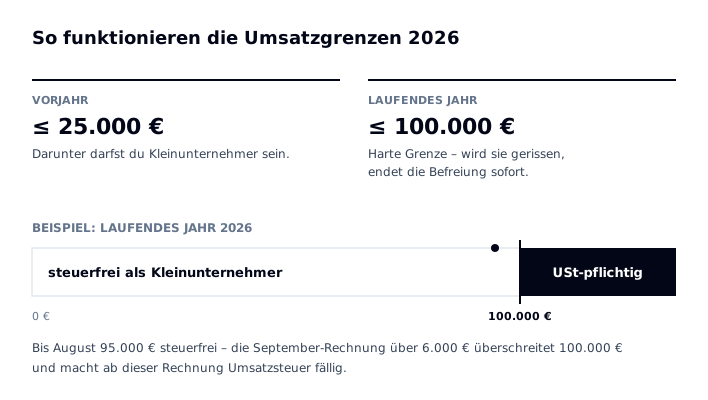
The €100,000 limit is now a hard ceiling. As soon as your current-year revenue exceeds €100,000, the exemption ends immediately — from exactly the sale with which you breach the limit. Everything before stays tax-free; everything from that moment is subject to standard taxation.
Example: Your 2025 revenue was €24,000, so you start 2026 as a Kleinunternehmer. By August 2026 you've billed €95,000. In September you issue an invoice for €6,000. With that invoice you exceed €100,000 — so you must show and remit VAT on those €6,000 and on all further sales that year.
| Point in 2026 | Cumulative revenue | Status |
|---|---|---|
| January–August | €95,000 | tax-free (Kleinunternehmer) |
| September (€6,000 invoice) | €101,000 | VAT liable from this invoice |
| from October | growing | standard taxation |
If, on the other hand, you stay under €100,000 but exceed the €25,000 prior-year limit, you only switch to standard taxation on 1 January of the following year. Our guide to switching from Kleinunternehmer to VAT-registered walks through the exact process, including input-VAT adjustment and your first VAT pre-return.
How to invoice as a Kleinunternehmer
As a Kleinunternehmer, your invoices must not show any VAT. Required fields include:
- Full name and address (yours and the customer's)
- Tax number (Steuernummer) or VAT ID (USt-IdNr.)
- Invoice date and sequential invoice number
- Service description and date/period of service
- Net amount — no VAT shown
- Mandatory note referencing the §19 UStG exemption
Since 2025 you have more flexibility on the note: colloquial wording is enough, e.g. "Umsatzsteuerbefreiter Kleinunternehmer nach §19 UStG" (VAT-exempt small business under §19 UStG) or "Kein Ausweis der Umsatzsteuer gemäß §19 UStG". Important: you must not show any percentage or VAT amount — not even "0% VAT". If you do, you owe that stated tax to the Finanzamt anyway.
For invoices up to €250 gross, a simplified small-value invoice is enough. Our overview of the mandatory invoice fields shows what larger invoices must contain.
The starter book for your self-employment
Free e-book: registration, accounting, your first invoice, and taxes — plus a tax calendar, deductions cheat sheet, and invoice template.
Less admin: VAT returns, annual filing and e-invoicing
The biggest practical benefit of the exemption is fewer VAT obligations:
- No VAT pre-return (UStVA): since you don't owe VAT or claim input VAT, the monthly or quarterly pre-return is dropped.
- No annual VAT return: since the 2024 tax period, the Wachstumschancengesetz means Kleinunternehmer no longer have to file an annual VAT return either — unless the Finanzamt requests one or special cases like the §13b reverse charge apply. Details in Kleinunternehmer and the annual VAT return.
- E-invoicing: you don't have to issue e-invoices as a Kleinunternehmer. But: since 1 January 2025 you must be able to receive them — an email address is enough. What that means in practice is covered in E-invoicing for small businesses.
What doesn't disappear: your income tax return and the EÜR (cash-basis profit calculation) — as a Kleinunternehmer you still determine your profit via the income-surplus statement.
Benefits of the exemption
- Less admin: no VAT pre-returns and no annual VAT return.
- Competitive pricing for private customers: no VAT mark-up means lower prices for end consumers — or more margin at the same gross price.
- Simpler bookkeeping: no need to separate net and gross amounts, no input-VAT posting.
Downside: no input VAT deduction
The main drawback: you can't reclaim VAT on your business purchases. If you buy equipment, software or office supplies and pay 19% VAT, that cost stays with you.
Example: A €1,000 net laptop costs you €1,190 as a Kleinunternehmer — but effectively only €1,000 for a VAT-registered business, which reclaims the €190 as input tax.
There's also an image aspect: some business clients read a missing VAT line as a sign of low revenue. Which downsides weigh heaviest in practice is examined in Reasons not to be a Kleinunternehmer.
Voluntary waiver: five years of commitment
You can voluntarily waive the exemption and opt for standard taxation — sensible if you have high upfront investments with a lot of input VAT, or serve almost only business clients. Careful: this waiver binds you for five calendar years. Only then can you return to the Kleinunternehmer scheme, so think the step through.
It often makes more sense not to be a Kleinunternehmer than to become one. The moment you invest in equipment, work mainly with business clients or expect to grow, the exemption costs you input VAT and flexibility. The benefit really only holds in one narrow case — when your customers are mostly private individuals and you don't plan to grow much. Otherwise, the Kleinunternehmerregelung is not a clear yes.
 Peter BoykoFounder of Norman
The EU small business scheme from 2025
Completely new since 2025 (in full effect in 2026): until now the exemption applied only to domestic sales. With the EU small business scheme you can now use the exemption in other EU member states too, without having to register for VAT in each one separately.
How it works:
- You register once with the Federal Central Tax Office (BZSt) and state in which EU countries you want to use the scheme.
- You receive a small business identification number (KU-IdNr.) that starts with the country code and ends in "-EX" (e.g.
DE…-EX). - Your EU-wide total revenue must not exceed €100,000 per year — on top of each country's national limits.
- You file a quarterly revenue report with the BZSt, due by month-end after each quarter (30 April, 31 July, 31 October, 31 January).
For purely domestic freelancers nothing changes. But anyone with clients elsewhere in the EU can avoid burdensome registrations.
When does the exemption make sense?
The Kleinunternehmerregelung makes most sense when:
- you primarily serve private (B2C) customers,
- your business expenses are low (little input VAT to reclaim),
- you're in the early stage with uncertain revenue.
It makes less sense if you mainly work with B2B clients (who reclaim VAT anyway and don't care about it) or regularly invest in expensive equipment whose input VAT you'd forfeit.
Don't confuse the Kleinunternehmerregelung with a Kleingewerbe: one is a VAT choice (§19 UStG), the other a commercial-law size category. The difference is explained in Kleingewerbe vs. Kleinunternehmer.
Frequently asked questions
What is the threshold for Kleinunternehmer in 2026?
Your prior-year revenue must be under €25,000 and your current-year revenue under €100,000. Both conditions must be met.
What happens if I exceed the threshold?
If you exceed €100,000 in the current year, you become VAT-liable from exactly the sale with which you breach the limit. If you only exceed the €25,000 prior-year limit, you switch on 1 January of the following year.
Does a Kleinunternehmer have to file a VAT return?
Since the 2024 tax year, generally no — neither the annual VAT return nor the pre-returns. Exceptions: a request from the Finanzamt or special cases such as the §13b reverse charge.
Do I need a VAT ID as a Kleinunternehmer?
For purely domestic sales your tax number is enough. You need a VAT ID (USt-IdNr.) as soon as you buy or supply goods or services across EU borders.
Can I voluntarily waive the exemption?
Yes. The waiver pays off with high investments or pure B2B business — but it binds you to standard taxation for five calendar years.
Does a Kleinunternehmer have to issue e-invoices?
No. But since 2025 you must be able to receive e-invoices; an email address is enough.
Conclusion
Germany's small business VAT exemption is a great way for newcomers to start with less bureaucracy. The €25,000 threshold makes it accessible to more freelancers — but the new hard €100,000 ceiling means you must keep an eye on your current-year revenue. Once you grow beyond it, you'll need proper VAT tracking — Norman AI Bookkeeping handles VAT returns and receipts automatically. Learn more about taxes for the self-employed in Germany.
When you cross the threshold, Norman takes over the VAT
As a Kleinunternehmer you issue invoices with the correct §19 note in Norman — free and unlimited. Cross the threshold and Norman switches to standard taxation seamlessly: VAT on your invoices, automatic VAT returns and input-VAT deduction from your receipts. So you never miss the switch.