Deduct a Camera in Germany 2026: Self-Employed, Creator, Photographer

Diana
Updated on:
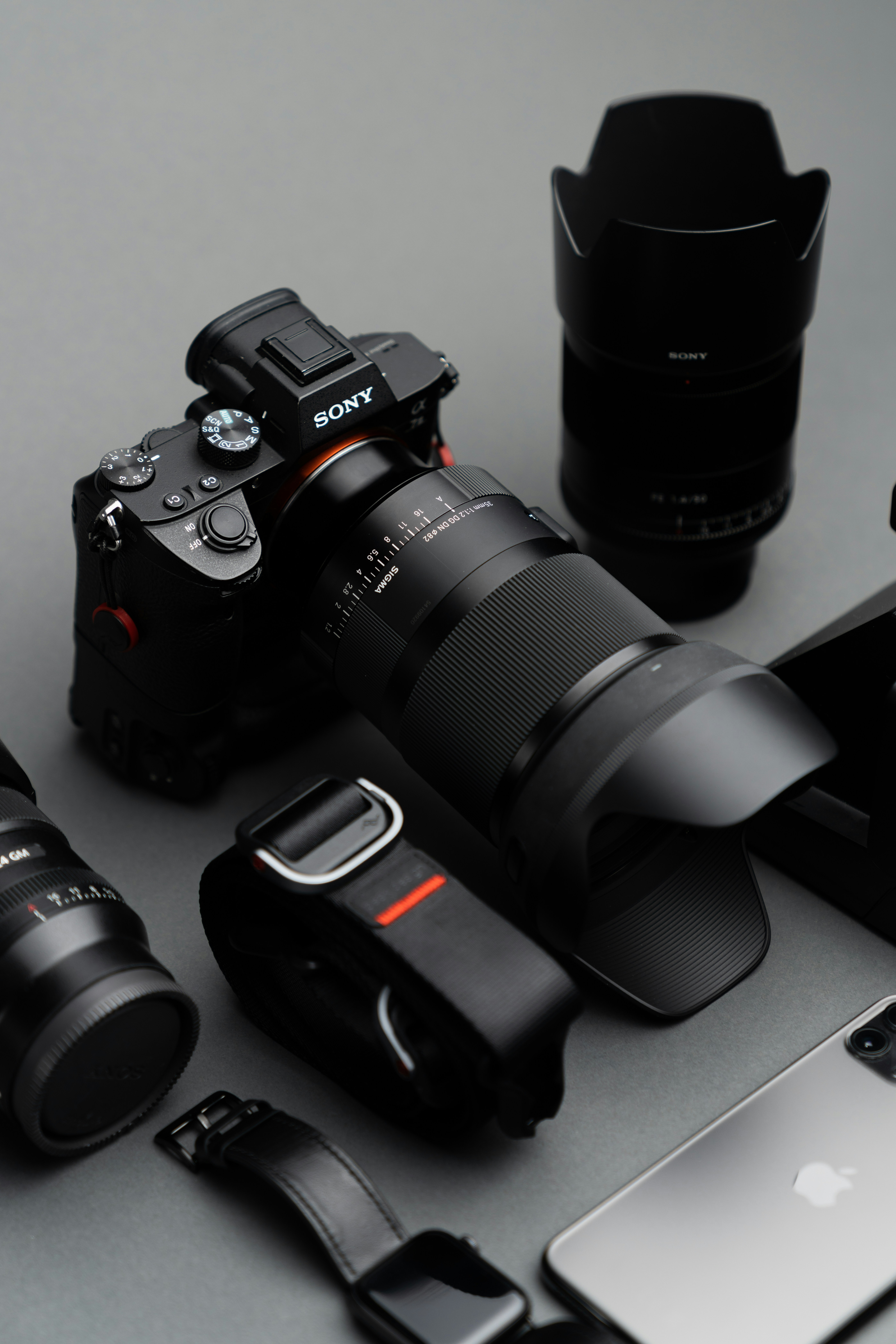
A Sony A7 IV with a kit lens runs €3,500, a compact Sony ZV-1 for vlogging is around €750, and a pro setup with two lenses, a tripod, and a microphone can hit €8,000. If you take photos, shoot video, produce reels for clients, or work as a creator in Germany, the camera is a business expense — but the rules are stricter than for a laptop. Here's when you can write it off immediately, when you have to depreciate it over 7 years, and how to handle VAT and private use cleanly.
Can I deduct my camera in Germany?
Yes — if you use it for your self-employed work. For some professions it's obvious: photographers, videographers, UGC creators, content creators, journalists, influencers, architects, real-estate agents, event producers. Even outside of "photo" trades, the camera is deductible when you produce your own marketing material, product shots, reels, or tutorials — typical for coaches, online-shop owners, trainers, and consultants who maintain a social presence.
The catch: the Finanzamt looks at cameras more closely than at monitors. A camera is trivially easy to use privately — on holidays, at family events, on weekends. You need to make the business use plausible. Full-time photographers don't need to explain anything. People who "occasionally take photos for the website" need to be honest about the private-use share.
Book your camera in 30 seconds, not 30 minutes
Norman scans your invoice from Calumet, Foto Erhardt, Sony, or Amazon Business automatically from a phone photo, files it as equipment, and pulls the input VAT into your next UStVA. For purchases above €800 net, Norman spreads the depreciation over the right useful life automatically.
Instant write-off or 7-year depreciation — the key question
Unlike monitors and laptops, a camera does not qualify for the one-year instant write-off for "computer hardware" introduced by the BMF letter of 22 February 2022. Webcams are explicitly on the list, traditional photo and video cameras are not. So you fall back on the standard depreciation logic.
The official German depreciation table (AfA-Tabelle) sets the useful life for "photo and film equipment" at 7 years. Drones and dedicated film cameras are sometimes set at 5 years. From there, you have three paths depending on the net purchase price:
Net purchase price | Method | How you depreciate |
|---|---|---|
Up to €800 | GWG instant write-off | 100% in the year of purchase |
€250 – €1,000 | Pool depreciation (Sammelposten) | 20% per year over 5 years, all qualifying purchases bundled |
Above €800 (or above €1,000 in the pool) | Linear depreciation | 1/7 of the price per year over 7 years |
Important: each year, you have to pick GWG plus standard depreciation for big-ticket items, OR pool depreciation plus standard depreciation. You can't run both methods in parallel in the same year. For most freelancers, GWG is the easier path.
Example 1: Sony ZV-1 for €750 net
Below €800 net → GWG. You book the camera fully as a business expense in the year of purchase. At a 35% marginal rate, you save about €263 in income tax instantly, plus VAT.
Example 2: Sony A7 IV with lens for €3,500 net
Above €800 net → 7-year depreciation. You expense €500 per year. In the year of purchase, the depreciation is pro-rated by month — buying in May means 8/12 of €500 = €333 in year one, the full €500 in years two through seven, and the remaining €167 in year eight.
Example 3: Lens for €600 net and body for €2,200 net in the same year
The body depreciates over 7 years. For the lens, you have a choice: GWG (€600 deducted immediately) or pool depreciation (combined with other purchases between €250 and €1,000 over 5 years). If you have no other pool-eligible purchases that year, GWG wins clearly.
Private use: where the Finanzamt looks closely
Honestly estimating business use is the topic that triggers the most discussions for cameras.
1. Almost exclusively business (over 90%)
You're a full-time photographer, videographer, or content creator and the camera is your work tool. You can deduct 100%. Holiday photos with the same camera are fine, as long as that's not the primary use pattern.
2. Mixed use (10–90% business)
Typical case: a coach, consultant, or online-shop owner who produces content regularly but also uses the camera privately. You estimate the business share and document it. A statement like "70% business" is fine if you can back it up (e.g. "two shoots per month, four hours each, plus two hours of weekly reel production"). Proof helps: a brief calendar overview or a photo folder with dated business assets calms any audit.
3. Mostly private (under 10% business)
If you only shoot a product photo once a quarter, the camera doesn't clear the 10% threshold. It stays in private property. You can still claim individual business uses through travel-expense reports or per-task expenses — though that's rarely worth it for cameras.
VAT: when you reclaim 19%
If you're VAT-registered (i.e. not a Kleinunternehmer under §19 UStG), you reclaim 19% input VAT on the gross price. On a €3,500 net / €4,165 gross camera, that's €665 — claimed in the monthly UStVA filing for the month you received the invoice.
Conditions: you need a proper invoice with VAT shown separately (Foto Erhardt, Calumet, Sony Business, etc. issue them when you order as a business customer), and the camera must be used at least 10% for business. The input-VAT recovery is independent of the income-tax depreciation — you reclaim the VAT in full in the month of purchase, even when you spread the income-tax deduction over 7 years. More on the mechanics on our UStVA page.
For mixed use, you may need to reduce the VAT recovery proportionally. In practice, if business use is at least 50%, you can fully assign the camera to business assets, reclaim the full VAT, and tax the private use later as a "free-of-charge supply" (unentgeltliche Wertabgabe). For most creators that's the most efficient setup — when in doubt, check with a tax advisor.
Worked example: pro setup for UGC production
You're a UGC creator and buy the following in May 2026: Sony A7 IV (€2,500 net), 24-105mm lens (€1,300 net), Røde VideoMic Pro (€200 net), tripod (€150 net), two SD cards (€80 net). Total: €4,230 net / €5,034 gross. You use the kit 90% for business.
Body (€2,500) + lens (€1,300): 7-year depreciation each → €357 + €186 = €543 expense per full year; pro-rated in year one (8/12)
Microphone (€200) + tripod (€150) + SD cards (€80): all under €800 → GWG, instant €430 expense in 2026
Input VAT: 19% on €4,230 = €803, fully claimed in May 2026 UStVA
Year-one income tax saving (35% marginal rate): roughly €277 (on €793 deductible in the purchase year)
Total income tax saving over 7 years: €3,800 × 35% body+lens = €1,330 + GWG year-one effect of about €150 = roughly €1,480 less income tax
Effectively, the €5,034 setup costs you about €2,750 over the depreciation period. To plug in your own marginal rate, use our tax calculator.
How to book the camera correctly
You record the camera as a fixed asset or as an immediately deductible business expense — depending on price and method.
SKR03 (above €800 net): Account 0410 (Geschäftsausstattung) against bank, annual depreciation booking on account 4830 (Abschreibungen auf Sachanlagen)
SKR04 (above €800 net): Account 0650 (Geschäftsausstattung) against bank, depreciation on account 6220
GWG (up to €800 net): SKR03 account 0480 / SKR04 account 0670, fully in the year of purchase
EÜR form: for depreciation, the "Absetzungen für Abnutzung" line with a separate entry in the asset register; for GWG, the "Sofort abzugsfähige geringwertige Wirtschaftsgüter" line
In the asset register (Anlageverzeichnis), you log the date, net price, useful life, and annual depreciation. This is mandatory for depreciable items — and the first thing inspected during a tax audit. If you'd rather automate the receipt entry, see Norman vs. Lexoffice: depreciation schedules, asset register, and pool depreciation are maintained automatically once you scan the invoice.
Special cases: when cameras are easy (or hard)
You're a full-time photographer
Lucky case — business use is obvious. The 7-year depreciation still applies, the Finanzamt makes no exception. For background, see our article on the photography trade and the UStVA for photographers.
You're an influencer or UGC creator
The case has gotten clearer — anyone producing reels, TikToks, or UGC for brands has a clear business model. Just keep the line clean: a camera you also take on family holidays counts as mixed use, not 100% business. More on the tax classification in our Instagram influencer tax guide.
Drone cameras
Drones with built-in cameras (DJI, Autel) are depreciated over 5 years per the AfA table. Same threshold rules: under €800 net = GWG, above = linear depreciation. Filming for real estate, events, or architecture is generally accepted without issues — provided you have a valid drone license and liability insurance.
Camera bought privately, later moved into the business
If you bought a camera privately before going self-employed and now want to use it for business, you can transfer it at fair market value (Teilwert) into business assets. Depreciation then runs from the date of transfer over the remaining useful life. Caveat: you can't retroactively reclaim VAT.
Common mistakes — and how to avoid them
Mistake 1: Treating it like a laptop with one-year write-off
Photo and film cameras are not on the BMF computer-hardware list. Anyone fully expensing a €3,500 camera in the year of purchase will get caught at the next audit. Only webcams (as "computer peripherals") qualify for the one-year instant write-off.
Mistake 2: Buying privately at Saturn without a business address
A receipt without your business name = no input VAT recovery. Order from Calumet, Foto Erhardt, Sony Pro Support, or Amazon Business as a business customer. Online orders are easier than in-store, since the address is pulled from your business account.
Mistake 3: Booking lens and body as one asset
Per BFH (Federal Tax Court) jurisprudence, body and lens are independently usable assets. You treat them separately: a €600 lens is GWG (instant 100%) even when the body runs over 7 years. Bundling everything into one position throws away the GWG advantage.
Mistake 4: Hiding private use
A camera you also take on holiday will be questioned routinely. An honest estimate (e.g. "80% business") protects you better than a 100% claim that collapses during an audit — at which point back taxes plus interest become due.
Mistake 5: VAT in the wrong month
What matters for VAT recovery is the invoice date, not the payment date. If you order in May but receive the invoice in June, the VAT goes into the June UStVA. Reverse-charge deliveries from EU vendors (Sony Italy, Amazon Lux) follow special rules — you enter both German input VAT and acquisition VAT yourself. See our reverse-charge guide for the mechanics.
Common questions
Can I deduct accessories like memory cards, batteries, and bags separately?
Yes — and you should. Memory cards, batteries, battery grips, straps, camera bags, cleaning kits are independent assets. Below €800 net they qualify as GWG, so they're fully deductible immediately. They don't have to be tied to the depreciation life of the main camera.
What if I sell the camera before the 7 years are up?
You stop the depreciation pro-rated in the year of sale and book the proceeds as business income. The remaining book value is offset against the proceeds. Example: camera bought for €3,500 in May 2026, sold for €1,800 in June 2029. Book value after 3 years of depreciation ≈ €2,000. Loss of €200 booked as business expense. If you make a profit, you tax it.
Is leasing or rent-to-own worth it?
For very high-end setups (cinema cameras above €10,000), leasing can make sense, since the lease payment is fully expensed in the year you pay it — no 7-year stretch. For most photo cameras, buying is cheaper and administratively simpler.
Do I have to log the camera in the asset register?
For multi-year depreciation: yes, mandatory. For GWG, you must keep a running log of items between €250 and €800 net (date, description, cost). Below €250 net the receipt alone is enough.
Smartphone as camera replacement?
If you work as a creator or UGC producer exclusively with an iPhone, the phone is the actual recording device — fully deductible under the smartphone rules. See our article on deducting a smartphone. Unlike a photo camera, a smartphone qualifies for the one-year instant write-off.
Conclusion
A camera is well deductible for self-employed people in Germany, but it's not the "instant 100%" deal a laptop is. Below €800 net: GWG, full deduction in the year of purchase. Above: 7-year depreciation (5 years for drones). Input VAT is always reclaimed in full in the month of purchase — independently of how the income-tax deduction is spread. If you also use the camera privately, estimate the business share honestly and document it. A correct entry in the asset register is mandatory and the first thing checked during an audit. If you'd rather have depreciation, asset register, and VAT handled automatically, see Norman vs. sevdesk or check how the tool books your gear in the equipment deductibles overview.