Deduct Your Printer in Germany 2026: Inkjet, Laser & Multifunction Devices

Diana
Updated on:
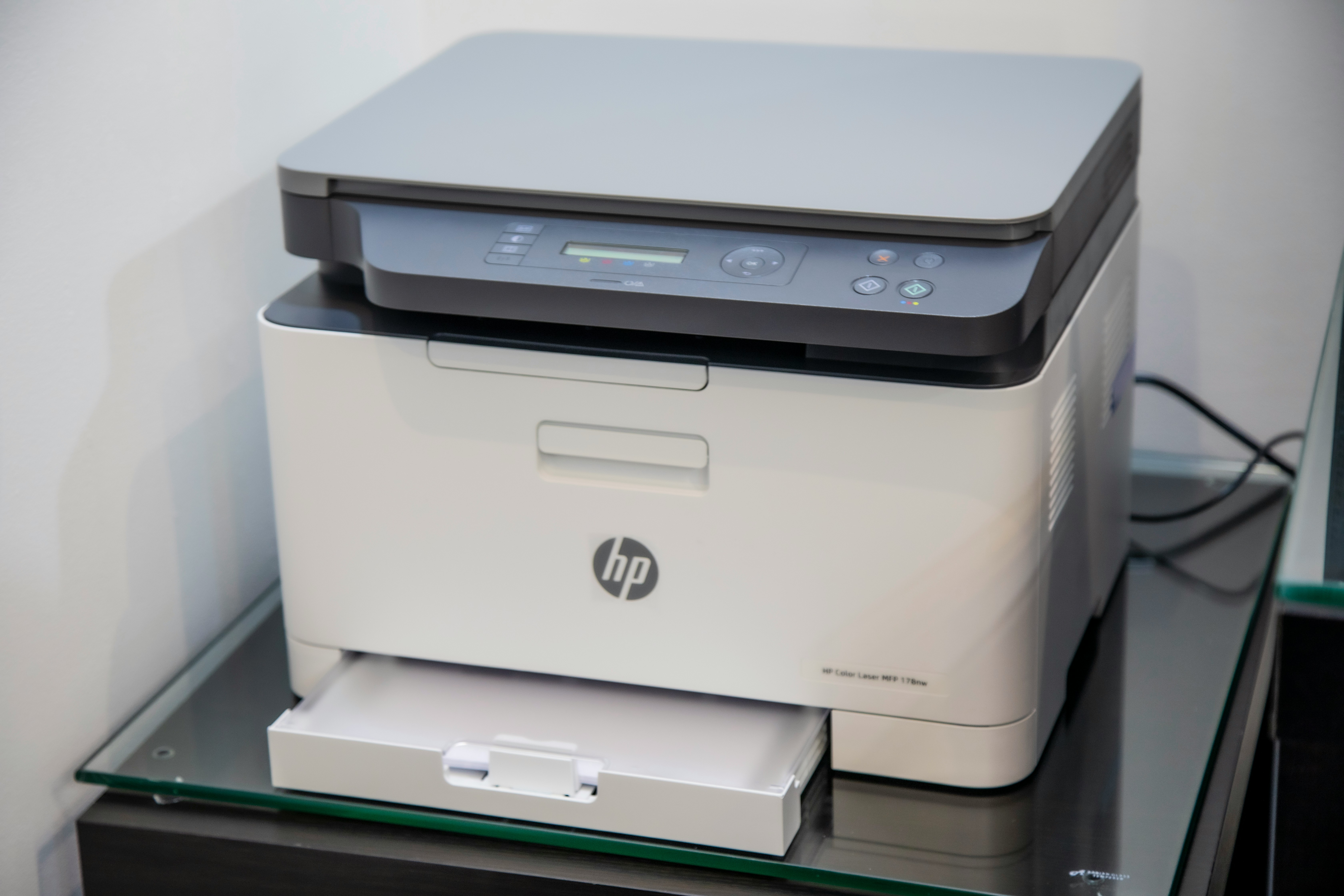
A basic inkjet printer costs €80, a decent all-in-one device €250, a business laser printer with duplex and networking €500 and up. Toner and ink keep adding up year after year on top. Good news for self-employed professionals in Germany: printers and scanners are explicitly named on the BMF's "computer hardware" list — you can write them off 100% in the year of purchase since 2021. Here's what's actually allowed, how to book toner, paper, and consumables separately, and which mistakes happen most often in a home office.
Can I deduct my printer in Germany?
Yes — if you use the printer for your self-employed work, it's a business expense (Betriebsausgabe). This applies to freelancers, sole traders, tradespeople, and incorporated entities like UG and GmbH. What matters isn't what the invoice says, but how you actually use the device. Anyone who regularly prints invoices, contracts, receipts, delivery notes, shipping labels, or reminders has no issue — even if the printer happens to sit in the living room.
Employees can also deduct a printer as work-related expenses (Werbungskosten) when they use it for work and their employer doesn't provide one. This article focuses on the self-employed case, where the rules are most generous and you recover 19% VAT on top of the income-tax deduction.
Book printer, toner, and paper in 30 seconds instead of 30 minutes
Norman scans your invoice from Brother, HP, Epson, or Amazon Business automatically from a phone photo, files it under the right category, and pushes the VAT into your next UStVA filing. You snap the receipt, the rest runs in the background.
The key rule since 2021: 100% instant write-off
Until the end of 2020, printers had to be depreciated over three years — a €600 laser printer showed up in your tax return as just €200 per year. Since the BMF letter of 26 February 2021 (clarified on 22 February 2022), "computer hardware and software for data input and processing" is treated as having a one-year useful life. The official list explicitly names "printers" and "scanners."
In plain terms: whether your printer costs €80 or €1,800, you can deduct the full purchase price in the year you bought it. The rule still applies unchanged in 2026. It doesn't matter whether you buy a simple inkjet, a multifunction device (printer + scanner + copier + fax), or a networked business laser — all of them fall into the same bucket.
The instant-write-off list also covers, around the printer itself:
Multifunction devices (printer/scanner/copier/fax in one chassis)
Stand-alone scanners and document scanners (e.g. Fujitsu ScanSnap, Brother ADS)
Label printers for shipping and warehouse logistics (Brother QL, Zebra)
Receipt and POS printers (Epson TM, Star)
Print servers, network print boxes, USB print adapters
Printer drivers and PDF tools
For a broader overview of typical work equipment, see our list of equipment deductibles. If you also want to deduct a laptop or deduct a monitor, the exact same rule applies.
How much can you deduct? (Full vs. mixed use)
As with any work equipment, the Finanzamt distinguishes between three scenarios. For printers, though, the "business vs. private" question rarely gets complicated in practice.
1. Almost exclusively business (over 90%)
You print invoices, order confirmations, delivery notes, contracts, DHL shipping labels, and occasional bookkeeping receipts. Private printing is rare or non-existent. Then you deduct 100% of the purchase price — the default situation for most freelancers who work without an assistant.
2. Mixed use (10–90% business)
If the printer sits in the living room and your kids regularly print homework and photos on it, you have to estimate the business share and only deduct that part. Example: 60% business use of a €400 printer gives you a €240 deduction.
A realistic rule of thumb is the page-count ratio: if your printer logs 4,000 pages a year and you can show 2,800 business prints in your records, you're at 70%. Write the estimate down in a short note — during an audit, the Finanzamt may want to see how you arrived at the number.
3. Mostly private (under 10% business)
If business use is below 10%, the printer counts as private property — the costs are not deductible. With a dedicated office device, this almost never applies.
VAT: when you get 19% back
If you're VAT-registered (i.e. not a Kleinunternehmer under §19 UStG), you also recover the VAT on top of the income-tax deduction. On a €595 gross purchase, you reclaim €95 in input VAT — your effective net cost drops to €500.
Conditions: you need a proper invoice with VAT shown separately, and the device must be used at least 10% for business. For printers at a workstation, the 10% threshold is trivial. More on the small-business status in our Kleinunternehmer guide.
You claim input VAT in the UStVA filing for the month you received the invoice — not at year-end. Buy the printer in March, the VAT recovery already appears in the March UStVA.
Worked example: a business multifunction device for the home office
In June 2026 you buy a Brother MFC-L8390CDW color laser multifunction device for €650 net, plus two original toner sets for €240 net, plus 5,000 sheets of paper for €40 net. Total: €930 net / €1,107 gross. You use the device 100% for business.
Business expense — printer (EÜR): €650 in 2026 — fully, with no spreading
Business expense — toner + paper: €280 in 2026 (consumables, immediate anyway)
Input VAT recovery: €177 in the June 2026 UStVA
Income tax saving (assuming 35% marginal rate): €930 × 35% = €326 less income tax
Effective cost: €1,107 − €177 − €326 = €604
Instead of €1,107, you effectively pay around €604 — the state covers nearly 46% of the cost. To estimate this for your specific tax bracket, use our tax calculator.
Toner, ink, paper: booking consumables correctly
The printer itself is an instant write-off. Consumables are even simpler — they count as office supplies from day one and are deducted in the year you buy them. There is no spreading across multiple years.
Toner and ink cartridges: office supplies (Bürobedarf), full instant deduction. SKR03 account 4930, SKR04 account 6815.
Printer paper (A4, A3, labels, shipping labels): office supplies, full instant deduction.
Cleaning wipes, roller cleaners, drum units: office supplies or repair and maintenance, full instant deduction.
Repairing a broken printer by a technician: immediately deductible as repair costs.
This has a nice side effect: if you want to push profit down at year-end, stocking up on original toner for next year's needs can shift the timing — as long as you physically received the toner. But be careful: buying three years' worth of toner all at once invites a charge of profit manipulation. Stick to plausible quantities.
How to book the printer correctly
You record the printer as a business expense in your EÜR or balance sheet. Depending on your chart of accounts, the typical posting looks like:
SKR03: Account 4855 (instant depreciation hardware/software) against bank/cash — for net price up to €800, alternatively account 0480 (low-value asset, GWG)
SKR04: Account 6260 (instant depreciation computer hardware) against bank/cash — for net price up to €800, alternatively 0670 (GWG)
EÜR form: "Immediately deductible acquisition costs" or "Depreciation — pool/instant write-off"
In practice, the exact account number doesn't matter, as long as the booking lands in the instant-write-off bucket. The one thing to avoid: don't accidentally pick the old 3-year depreciation, or you'll push two-thirds of the tax saving into next year and the year after. Modern accounting software handles this automatically; for a direct comparison of tools for the self-employed, see Norman vs. Lexoffice.
Printers in the home office: the special cases
Most freelancers print at home. Three things often go wrong:
Dedicated home office vs. desk in the corner
Whether you have a fully deductible home office or just a desk in the living room is irrelevant for the printer — work equipment like printers, screens, and laptops stays fully deductible either way. The home-office room rules only affect rent, utilities, and renovation, not the equipment itself. More on this in our article on deducting the home office.
A printer at home and one at a co-working space or client
You can deduct both — as long as you actually use both. For freelancers who commute, this is a typical case. For more than two printers per person, keep a plausible explanation in your records (for example, a label printer for shipping plus an all-in-one for general correspondence).
Selling or gifting an old printer
If you sell an old business printer (on eBay Kleinanzeigen or a refurb platform), the proceeds count as business income — record it in your EÜR. If you give it to a family member, that's a withdrawal at current market value. A three-year-old printer often resells for just €30–80, so the tax impact is minimal.
Common mistakes — and how to avoid them
Mistake 1: Buying privately at MediaMarkt without a business address
A receipt without your name doesn't qualify for input VAT recovery. Order the printer as a business customer and ask for an invoice with your company name — HP Business, Brother Direct, Amazon Business, and MediaMarkt's business portal all do this without a price premium.
Mistake 2: Forgetting the consumables
Toner, ink, paper, drums — all immediately deductible. Over a year, €200–600 in consumables stack up, often on separate receipts that get lost during year-end clean-up. If you scan receipts via photo, nothing falls through the cracks.
Mistake 3: Booking in the wrong year
What counts is the year of acquisition — when you received the printer, not when you paid the invoice. If you order in December 2026 but the device arrives in early January 2027, the booking belongs in 2027.
Mistake 4: Wrong VAT treatment on EU purchases
Printers from EU vendors (e.g. HP B2B Netherlands or Brother Direct via another EU country) come with a net invoice and a reverse-charge note. You then enter both German input VAT and acquisition VAT in the UStVA yourself — many freelancers miss this. See our reverse-charge guide for the mechanics.
Mistake 5: Misclassifying a subscription
Many manufacturers (HP Instant Ink, Brother Refresh EZ Print, Lexmark Smart) offer printers as a subscription or print-flatrate. That's not a capital purchase — it's an ongoing operating expense. Book the monthly payment directly as expense, not as depreciation. The upside: you can cancel anytime and don't have to enter anything on the fixed-asset side.
Common questions
Can I deduct ink cartridges separately?
Yes — toner and ink are consumables and are fully deductible in the year of purchase, independent of the printer itself. Even a small stockpile (say, three original toner sets) is fine, as long as it's a reasonable supply for typical print volume over a short period.
What about printer paper?
Printer paper counts as office supplies — fully deductible in the year of purchase. The same applies to specialty paper (photo paper, label sheets, DHL shipping labels, glossy stock for business cards).
Multifunction device: only the printer, or also the scanner and fax?
The whole device, as one unit. Printer, scanner, and fax module all fall under the BMF instant-write-off list. There's no functional split — a multifunction device is treated exactly like a stand-alone printer.
What about a 3D printer?
3D printers are not on the BMF list because they're used for manufacturing, not for "data input and processing." The regular depreciation table still applies here — typically a 5- to 8-year useful life. For a hobby-grade 3D printer at €300, however, you can use the GWG rule (net price up to €800, fully deductible in the year of purchase).
Do I have to enter a printer in the asset register?
Under the one-year instant write-off, there's no formal obligation to keep a fixed-asset register. Still, I recommend a quick log of every purchase over €250 net (date, amount, device) — it costs 30 seconds per receipt and helps enormously during an audit.
Is it worth buying at year-end?
If you've had a strong year and want to reduce the tax bill: yes. A €600 printer in December cuts your profit by €600 and saves around €210 at a 35% marginal rate. If you were planning to replace the old device anyway, December beats January.
What if I don't print, only scan?
A stand-alone document scanner is also explicitly on the BMF list — fully deductible in the year of purchase. If you just digitize incoming invoices, a ScanSnap or Brother ADS for €250–400 often makes more sense than a bulky multifunction device.
Bottom line
A printer is one of the easiest business expenses for self-employed professionals in Germany in 2026. Since 2021, you can deduct the full purchase price in the year you buy it — whether it's an €80 inkjet or a €1,500 color laser. Toner, ink, and paper run directly as office supplies anyway. The three things that matter: a proper invoice in your name, an honest estimate of private use (rarely an issue with office printers), and the right booking as instant depreciation. If you'd rather automate this than enter every toner purchase by hand, take a look at Norman vs. Accountable — receipt capture happens via photo in seconds, and the VAT lands automatically in your next UStVA filing.